Monday, 5 August 2019
THE WORSHIPPERS. By Victor Thorpe
The love the main hero, Paul Okoro, has for his lady, Aimee is endearing. There is a special chemistry between them from the first time they meet at a stadium, etc. She is beautiful, uncomplicated, understanding, and as he gets to learn, very tough in her own way. She is even something of an expert in the martial arts. She is also a professional, a young lawyer. She embodies the type of perfection, the wish-fulfillment of any young man I guess. But this is not to suggest that she is not real; she very much shares the hair-raising adventures of her man. Having said that, one finds it hard to believe - or imagine - that she kept on goading, more or less forcing her husband to consort with prostitutes!!
- M Chukwu
Wednesday, 24 July 2019
TRY THIS ONE FOR SIZE. By James Hadley Chase
The winner takes it all... but what
if eventually there is no winner at all despite the high stakes? Chase is one
of the few writers who can pull such a scenario off! Another brilliant plot
with a priceless icon involved; with international ripples.
Many characters made famous by the
author are present here; including proficient art thieves, the notorious,
ruthless Herman Radnitz, and Tom Lepski the indomitable Cop. As the story
unfolds, with the icon stolen, it becomes clear that all the parties involved
hardly trust each other, and are ready to double cross each other.
We are introduced to a new, young
unconscionable killer, the younger Holtz whose evil mien startles even the
cruel Radnitz himself. "Radnitz stubbed out his cigar (shaken). It was as
if death had walked out of the room, and Radnitz feared death..." The
action reaches a peak - with everybody somehow losing
-
Paul Lothane
Wednesday, 3 July 2019
GLIMPSES INTO AFRICAN LITERATURE. By I. Mzwandile Soqaga
This book
swiftly introduces the reader to African writing generally over the years, and
decades; including many key writers, and books. It is unfortunate that some
writers who might be household names in their home countries might not be known
at all in other African countries. But it is good to learn.
A negative
here is that too few female writers are focused on in this book, though in
general quite a number of them are mentioned. At least there is a chapter on
Grace Ogot, an early outstanding east African woman writer. I also liked the
tribute to Assia Djebar, a truly brilliant north African female scholar and
creative writer.
Essays here
include pieces on Ola Rotimi, Sonne Dipoko, Don Mattera, Peter Abrahams, Amos
Tutuola, Njabulo Ndebele, Flaxman Qoopane, Pule Lebuso, Okot
p'bitek, Mbulelo Mzamane, O Bolaji, Asare Konadu, and Camara Laye. There
is also an interesting piece on Literary Criticism/Critics in Africa.
-
Madolyn Chukwu
Monday, 17 June 2019
MY FATHER'S DAUGHTER. By Mabel Segun
'Biographies - make that autobiographies - of eminent Africans
can be tantalising. Such memorable works include those written by Nelson
Mandela, Wole Soyinka, Es'kia Mphahlele, Wellesley Cole, Mamphela Ramphele and
Ngugi Wa Thiong'o. The only woman mentioned here, Ramphele perhaps illustrates
the fact that such works involving women are thin on the ground - especially in
Africa. This particular book, My Father's Daughter was written long ago by one
of Africa's early illustrious female writers. She would, as a young woman study
with the likes of Chinua Achebe, at the university. Somehow this book of hers
became categorised as a book for the young, though it is much more than this,
despite the fact that the protagonist is a girl. She is a perceptive,
perspicacious girl, rather privileged, considering the time and society. This
was many many decades ago in Africa when the marvels of electricity could not
even have been dreamed of. But the girl here, daughter of a parson is
comfortable, inculcated with both religious and (western) education tutelage -
from an early age. The protagonist is intelligent and sensitive, and even at a
very young age enterprising and innovative. Yet the picture here is essentially
of sedate life which alas later morphs into trenchant tragedy when her father
dies! But the rudiments of a successful life has been put in place, the girl
has learnt many lessons, including basic chores and responsibilities, and a
penchant for education.'
Thursday, 30 May 2019
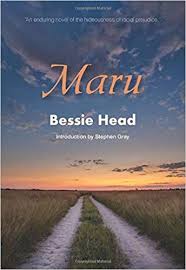
MARU. By Bessie Head
|
Why would TWO obviously very powerful men in one "rustic" society go after a woman
supposed to be an 'outcast"? Why would they pull out all the stops to
have her? .This is the situation we are confronted with here. Men are almost always
attracted to physical attributes of women, but the lady in question, Margaret
is not really described as a beauty or very desirable, though she is rather
educated. I think the author should have given us strong reasons why two such
important men would desire a woman most of society would frown down upon. But
it seems the author's main interest is to show the special powers of Maru,
the man in particular.
- Madolyn Chukwu
|
Tuesday, 14 May 2019
THE ADVENTURES OF SOUZA. By Kola Onadipe
This book used to be in our house for years, many years ago.
It was loved by my brothers in their youth, and later on I would read it too as
a young girl, or young woman.
It is a very good story for the young, exciting and
also frightening. Souza's adventures seem very much real and realistic and
quite dangerous too. I could have sworn then that these adventures did happen,
and the boy, and others was NOT a good boy!
Rural life brought to life in
brilliant African fashion, with the author very much part of the society -
hence the gripping reality. But having said that, with the benefit of hindsight
one can say this book, and others like it authored by Africans, are essentially
aimed at African boys, African males in their youth.
I hardly remember such
books aimed at the African girl with such popularity. So African female writers
were rare, which explained why one did not see such books that girls like
myself could identify with? Or maybe one just did not see such books then
written by our female writers, eg Flora Nwapa?
One did read the occasional
Nancy Drew book (for example), but such works of course were never aimed at the African young
woman.
- Lupna Avery
Subscribe to:
Posts (Atom)